


The short answer
Back cracking is often caused by normal movement within joints or by tendons and other soft tissues moving around nearby structures. An occasional sound without pain is not usually a reason for alarm. Pain, swelling, numbness, weakness or loss of movement matter more than the noise itself.
Key takeaways
- A cracking sound alone cannot identify which structure is moving.
- Joint cavitation is one proposed source of some joint sounds, but it does not explain every spinal click.
- Do not force your back to crack or ask someone to press or twist it.
- Persistent pain, tingling, weakness or reduced mobility deserve a professional assessment.
- New bladder or bowel changes, saddle numbness or progressive leg weakness need urgent medical attention.
In this article
- Why does your back make cracking sounds?
- Is it bad to crack your back?
- When should you worry about back cracking?
- What can you do if your back cracks frequently?
- How can a physiotherapy assessment help?
- Frequently asked questions
- What to do next
- Why does your back make cracking sounds?
Back cracking sounds can have several possible sources. They may come from movement within a joint, a tendon or ligament shifting over a nearby structure, or other soft-tissue movement. The sound alone cannot tell you which structure is responsible, and it does not prove that a vertebra has moved out of place.
One explanation for some joint noises is cavitation. When the surfaces of a joint move apart, pressure in the joint fluid can change and a gas cavity may form. A 2015 study published in PLOS ONE used real-time MRI to examine cavitation in finger joints. It helps explain one mechanism behind joint cracking, but it did not study spinal joints and should not be treated as proof that every back sound has the same cause.
A click can also occur when a tendon or ligament moves over a nearby structure. In the spine, several small joints and surrounding tissues move as you bend, turn or stretch. That is why the same person may notice a sound during one movement but not another. A clinician would need to consider the full pattern of symptoms and movement rather than diagnose the cause from the noise.
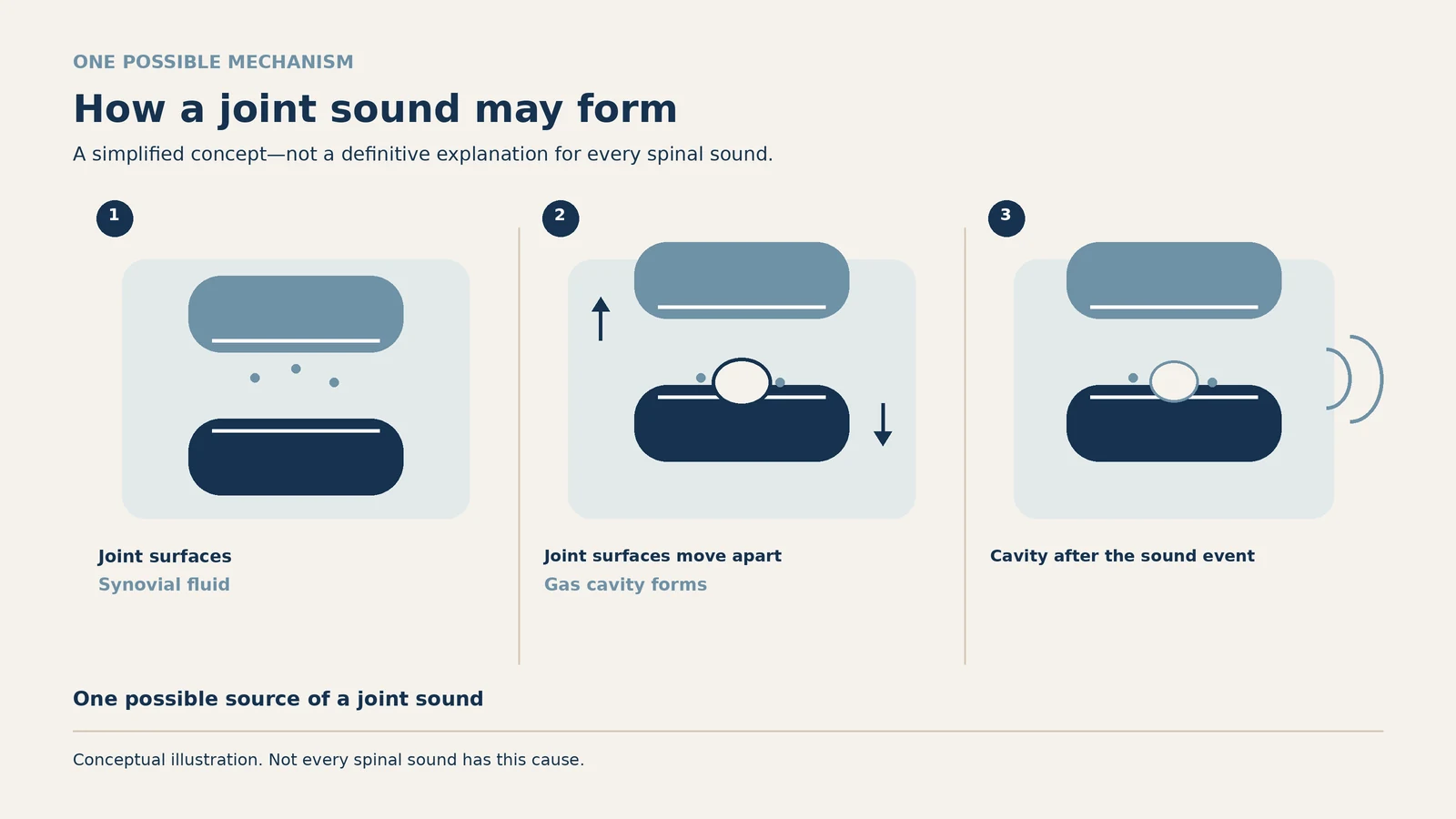
A simplified diagram of one proposed mechanism for some joint sounds; it does not explain every spinal click.
Is it bad to crack your back?
If your back occasionally clicks when you change position and you have no pain or other symptoms, the sound alone is not usually a reason to stop moving. It is not a reliable measure of spinal health, alignment or treatment success. You do not need to make the noise disappear simply because you can hear it.
The situation is different when you repeatedly twist or force your back to produce a crack, especially if you are doing it to manage pain. Forceful movements can aggravate an existing problem, and asking another person to push down on your spine is not a safe substitute for an assessment. Avoid copying manipulation techniques from social media or trying to make a joint crack when it does not move comfortably.
A qualified clinician may use manual techniques as one part of care for some people, but they are not essential for everyone and should follow an assessment. Treatment may instead focus on education, graded exercise, mobility, strength and changes to activities. A cracking sound during treatment does not prove that a joint has been put back into place.
When should you worry about back cracking?
The symptoms that accompany back cracking are more important than the sound itself. Arrange a healthcare assessment if the noise is associated with persistent or worsening pain, marked stiffness, swelling, reduced movement, a feeling of instability, tingling, numbness or pain that travels into a leg. These symptoms do not automatically mean there is a serious condition, but they deserve context and examination.
Seek urgent medical help if you develop new difficulty controlling your bladder or bowel, difficulty passing urine, numbness around your genitals or anus, or new or progressive weakness in your legs. Back pain after a significant accident or injury also needs prompt medical assessment. Do not wait for a routine physiotherapy appointment if these warning signs appear.
You should also contact a healthcare professional if back pain comes with fever or feeling generally unwell, unexplained weight loss, or a rapid deterioration. The right next step depends on your medical history, the onset of symptoms and the findings of an examination.
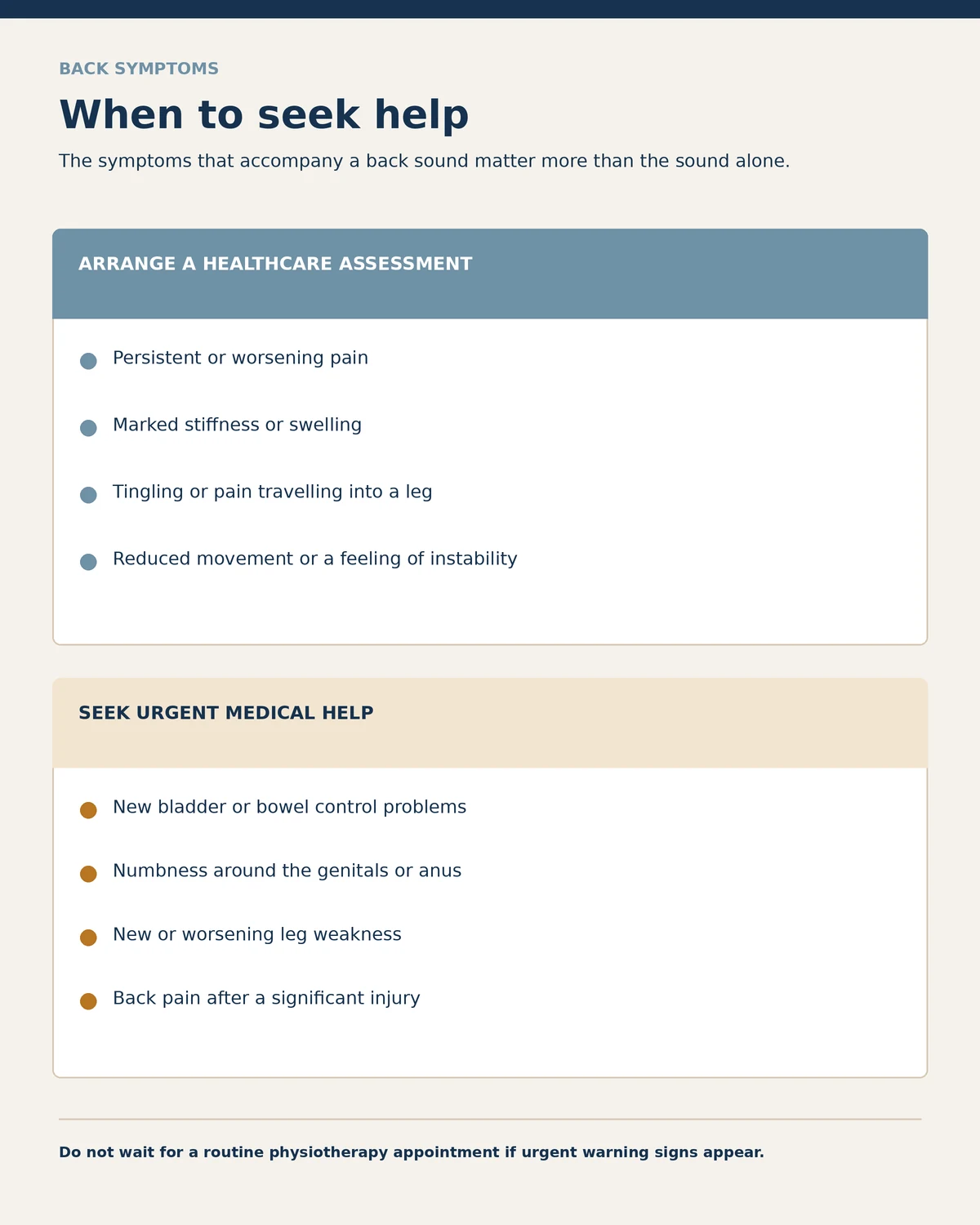
The symptoms that accompany a back sound matter more than the sound alone.
What can you do if your back cracks frequently?
Start by noticing when the sound happens and whether anything else changes at the same time. You do not need to monitor every movement; a few useful observations are enough to describe the pattern at an appointment.
- Notice the movement: record whether the sound happens when you bend, turn, stand up or stretch.
- Check for symptoms: note pain, tingling, numbness, weakness, swelling or reduced movement.
- Avoid forcing it: do not repeatedly twist or use another person’s body weight to produce a crack.
- Keep moving comfortably: change position regularly and choose activity that feels manageable.
- Adjust when needed: if a movement clearly increases pain, reduce the range or intensity and seek advice if it persists.
If you spend long periods sitting, changing position and taking comfortable walking breaks may help you stay active. Prolonged bed rest is not usually a helpful response to ordinary back pain. Choose activity according to your tolerance, and do not push through severe or escalating symptoms.
The aim is not to chase a particular sound. A more useful goal is to move with confidence, maintain the activities that matter to you and understand whether any associated symptoms need attention.

Comfortable, gradual activity can help people maintain everyday routines without chasing a cracking sound.
How can a physiotherapy assessment help?
A physiotherapy assessment looks at the person and the symptoms, not just the noise. The clinician may ask when the sound began, which movements bring it on, whether pain travels into an arm or leg, what makes symptoms better or worse, and how the problem affects sleep, walking, work or daily activities.
The physical assessment may include comfortable movement tests, strength, sensation, balance and how symptoms respond to different positions or activities. The exact checks depend on your history and presentation. Imaging is not automatically needed for every back sound; a clinician should explain when a test is likely to change the next step.
Depending on the findings, a plan may include clear advice, progressive therapeutic exercise, mobility work and manual techniques when appropriate. NordicFysio describes its advanced physiotherapy service as addressing conditions including low-back pain, herniated discs and sciatica. You can read about its advanced physiotherapy services if you want to understand the clinic’s stated approach.
A responsible clinician should also recognise when symptoms need medical assessment rather than routine physiotherapy. New bladder or bowel changes, saddle numbness, progressive weakness or significant trauma should be treated as urgent warning signs.

A physiotherapy assessment considers symptoms, movement and personal goals before a plan is chosen.
A clinical decision note
Do not use the sound as the treatment target. First establish whether there is pain, a meaningful loss of function or a neurological symptom. If the person is comfortable and moving normally, reassurance and sensible activity may be enough. If symptoms persist, worsen or include warning signs, the plan should be based on an appropriate clinical assessment rather than repeated attempts to produce a crack.
Frequently asked questions about back cracking
Is it bad if my back cracks every day?
Not necessarily. Frequency alone cannot show whether there is a problem. Pay attention to pain, swelling, tingling, weakness, locking or reduced movement. If you feel you must force your back to crack repeatedly to get relief, arrange an assessment rather than continuing to twist it.
Does back cracking mean I have arthritis?
No. A cracking sound by itself does not diagnose arthritis or spinal wear. A diagnosis depends on your symptoms, medical history and examination, with imaging considered only when clinically appropriate. If pain or stiffness is affecting daily life, speak with a healthcare professional.
Can a physiotherapist crack my back?
A physiotherapist may use a manual technique in selected cases, but treatment does not have to involve a cracking sound. Exercise, education, mobility work and other approaches may be more suitable. The choice should follow an individual assessment and your preferences.
Should I stop exercising if my back clicks?
A painless click alone is not usually a reason to stop all exercise. Keep activity comfortable and adapt movements that aggravate symptoms. Stop and seek advice if you develop significant pain, new tingling, weakness or a clear deterioration.
Why does my back crack when I stretch?
Stretching changes the position of joints and surrounding tissues, which can produce a click or pop. The sound does not identify the exact structure involved. If stretching is comfortable and there are no other symptoms, the noise alone is generally less important than how your back feels and functions.
Can I ask someone to crack my back for me?
It is better not to ask an untrained person to twist, press or force your spine. They cannot assess your medical history or whether a manoeuvre is appropriate. If you have pain or feel dependent on repeated cracking for relief, seek professional guidance.
What to do next
If your back makes an occasional sound but you feel well and move comfortably, you may not need to do anything about the noise. Avoid forcing a crack, stay active within your comfort and pay attention to any changes in symptoms. If pain persists, movement becomes limited or you notice tingling or weakness, arrange an assessment.
If you experience new bladder or bowel problems, numbness around the genitals or anus, progressive leg weakness or pain after major trauma, seek urgent medical attention rather than waiting for a routine appointment.
If you would like to explore your options, visit NordicFysio’s advanced physiotherapy service page and contact the clinic to ask whether an individual assessment is appropriate for your symptoms.