

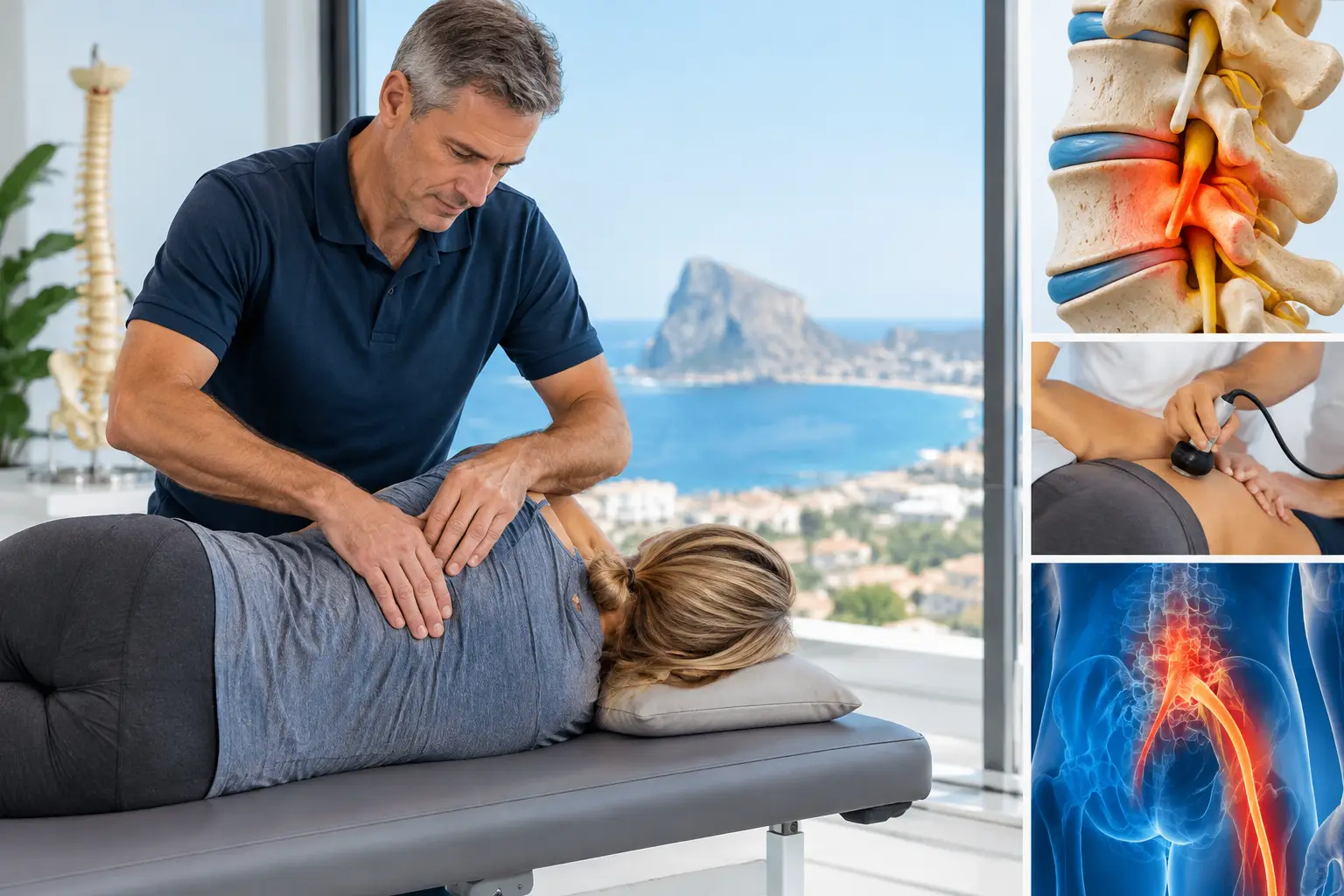
A short walk along the seafront should not require planning every bench stop. Yet many people with spinal stenosis describe exactly that: aching, heaviness, tingling or weakness building in one or both legs until they need to sit down or lean forwards. This spinal stenosis guide for Costa Blanca residents explains why that pattern matters, why scans do not tell the whole story, and what a careful next step can look like.
For adults who have already tried massage, exercises, medication, injections or treatment elsewhere, the most frustrating part is often not simply the pain. It is the uncertainty. You may be asking: is this really my back, is it my hips, is it poor circulation, or am I just getting older? The answer should not be guessed from a scan alone.
What spinal stenosis actually means
Spinal stenosis means narrowing of one or more spaces in the spine. These spaces contain the spinal cord or nerves travelling towards the arms, buttocks and legs. In the lower back, age-related changes such as disc bulges, arthritic joints, thickened ligaments and changes in posture can reduce the room available around the nerves.
This is common from midlife onwards. In fact, many people have narrowing visible on an MRI or CT scan but have no symptoms at all. That is the surprising and important point: a scan finding and a painful condition are not automatically the same thing. The clinical question is whether the narrowing matches your symptoms, movement limitations and examination findings.
Lumbar spinal stenosis affects the lower back and is the more common reason for leg symptoms when walking. Cervical spinal stenosis affects the neck and may produce symptoms in the arms, hands, balance or coordination. Both require proper assessment, but they do not present in exactly the same way.
The walking pattern that often raises suspicion
A typical lumbar stenosis story goes like this. Someone can manage a supermarket trolley better than standing in a queue. They may walk further when slightly bent forwards, such as when pushing a buggy or leaning on a railing. Standing upright, walking downhill or carrying shopping can bring on pain, numbness, burning, cramping or a feeling that the legs will not cooperate.
Sitting down, bending forwards or resting may ease the symptoms. This is sometimes called neurogenic claudication. It can feel like a circulation problem, which is why it should not be self-diagnosed.
Not everyone follows this pattern. Some people mainly feel buttock pain, one-sided sciatica or lower-back stiffness. Others have leg weakness without dramatic pain. Hip arthritis, vascular circulation problems, peripheral neuropathy and disc-related nerve irritation can create overlapping symptoms. A good assessment separates these possibilities rather than placing every leg symptom under one label.
Symptoms worth discussing with a clinician
Persistent symptoms that interfere with walking, driving, sleeping, getting up from a chair or confidence outdoors deserve attention. This is particularly true if your usual walking distance is shrinking or you are avoiding activities you enjoy because you cannot predict what your legs will do.
A clinician will usually want to know where symptoms travel, whether they affect one or both legs, what positions ease them, and whether coughing, standing, bending or stairs change the problem. They should also assess movement, leg strength, sensation, reflexes, balance and how your symptoms respond to certain positions. These details can be more useful than a scan report read in isolation.
When spinal stenosis needs urgent medical advice
Most spinal stenosis symptoms can be assessed calmly, but a few changes need urgent medical attention. Seek urgent medical help if you develop new loss of bladder or bowel control, numbness around the genitals or inner thighs, rapidly worsening leg weakness, or severe symptoms after a significant fall or accident.
New problems with hand coordination, marked balance deterioration, repeated unexplained falls or changes in walking alongside neck symptoms should also be medically assessed promptly. These signs do not automatically mean something serious is happening, but they should not be left to a routine exercise appointment.
Why rest and generic exercises may not be enough
Rest can temporarily settle an irritated back or leg, but too much avoidance often reduces strength, walking tolerance and confidence. Equally, being told simply to “strengthen your core” can be unhelpful if no one has established which movements aggravate your symptoms, whether your hips or nerves are contributing, or what your actual starting level is.
The aim is not to force a stiff spine into one perfect posture. It is to understand your individual tolerance and build capacity progressively. For one person, that may involve improving hip mobility and leg strength. For another, it may mean graded walking intervals, balance work, pacing, specific spinal movement, or managing a sensitive nerve response before loading is increased.
One useful principle is to work below the point where symptoms flare significantly, then progress gradually. If a ten-minute walk causes symptoms that settle quickly, several shorter walks may be more productive than one long walk that leaves you struggling for the rest of the day. The correct dose depends on your symptoms, overall fitness, medical history and goals.
A spinal stenosis guide for Costa Blanca patients seeking treatment
If you live in Torrevieja, Aguas Nuevas, Punta Prima, Ciudad Quesada or elsewhere on the southern Costa Blanca, it can be tempting to seek the quickest treatment during a flare-up. But when symptoms have lasted for months, the better question is often: why has this continued despite what I have already tried?
At NordicFysio, assessment-led physiotherapy starts with that question. The clinical team looks at the relationship between your symptoms, walking capacity, spinal and hip movement, nerve-related signs, strength and daily demands. Previous scans, injections and treatment history matter, but they are considered alongside what your body can and cannot do now.
Treatment may include advanced manual physiotherapy, the POLD Method, SCENAR neuromodulation where appropriate, therapeutic exercise and a rehabilitation plan. These are not interchangeable treatments or a standard package. The approach should be selected because it fits the findings of your assessment and should be reviewed against measurable changes, such as walking distance, sit-to-stand ability, leg strength, sleep or confidence outside the home.
For some people, conservative treatment can improve function and make symptoms more manageable. For others, symptoms remain limiting despite a well-planned rehabilitation programme, and medical or surgical opinion may be appropriate. A sensible physiotherapy plan recognises both possibilities. The goal is not to delay necessary medical care, but to help you make decisions based on a clear clinical picture.
What you can do while waiting for an assessment
Keep a brief record for a week. Note how long you can walk before symptoms start, whether standing is worse than sitting, where the symptoms travel, and how long they take to settle. Also record any change in leg strength, balance or sleep. This gives a clinician useful information and can help you notice patterns that are easy to overlook day to day.
Stay as active as your symptoms reasonably allow, without repeatedly pushing into a severe flare-up. Choose supportive footwear for longer walks, break tasks into manageable stages and use a trolley or walking aid if it helps you stay mobile safely. Do not stop prescribed medication without discussing it with the clinician who prescribed it.
Most importantly, do not dismiss a progressive loss of walking ability as an unavoidable part of ageing. Plenty of people in their fifties, sixties, seventies and beyond remain active, but persistent leg symptoms deserve an explanation that is specific to them.
A careful assessment cannot promise the same result for every spine. It can, however, replace guesswork with a clearer plan – so that walking to the café, standing to cook, travelling in the car or enjoying time with family feels less like a calculation and more like ordinary life again.