


Pain on the outside of your hip that flares when you lie on that side, climb stairs or walk the seafront is most often greater trochanteric pain syndrome, known in Spain as trocanteritis. In most people the sore spot is an overloaded gluteal tendon, not an inflamed bursa. In a 2018 trial published in the BMJ, eight weeks of education and exercise did better than a cortisone injection or waiting it out.
That is the short version. The longer version matters, because the habits that keep outer hip pain going are the ones almost nobody suspects: the way you sleep, the way you stand in a queue, and that low sunbed by the urbanización pool that takes three attempts and a groan to get out of.
What is trocanteritis, and why the name is a bit out of date
Trocanteritis is pain over the greater trochanter, the bony bump you can feel on the outside of your upper thigh. Two buttock muscles, gluteus medius and gluteus minimus, attach to that bump through flat tendons, and a small fluid-filled bursa sits over them. For decades the problem was called “trochanteric bursitis”, which suggests the bursa is inflamed.
Doctors and physiotherapists now prefer the name greater trochanteric pain syndrome (GTPS). Researchers adopted it because “bursitis” implies an inflammation that is often not there. In most people with this pattern, the gluteal tendons are the main source of pain: they have been squeezed and overloaded faster than they can adapt. That changes the treatment, because tendons get better with the right kind of load, and they rarely get better with rest alone.
Who gets outer hip pain on the Costa Blanca?
Greater trochanteric pain syndrome is common in people over 50. In a study of 3,026 adults aged 50 to 79, published in the Archives of Physical Medicine and Rehabilitation (Segal and colleagues, 2007), about 15% of women and 6.6% of men had it on one side, and 8.5% of women and 1.9% of men had it on both. It is one of the most common hip complaints we see across Orihuela Costa, Torrevieja and the Vega Baja.
On this stretch of coast the trigger is often a change in routine. Picture Ingrid (an illustrative example, not a real patient): 63, recently retired from Gothenburg to Playa Flamenca. Back home she walked a little and sat a lot. Now she walks the coastal path from La Zenia to Cabo Roig every morning, plays pádel twice a week, carries the shopping up two flights of stairs to her duplex and sleeps on her right side, as she always has. Nothing she does is wrong. She simply asked her hip tendons to do three times more work in a month, and they sent a complaint.
Common local triggers we hear about:
- A sudden jump in walking, especially on sand at La Mata or Guardamar, or on the hills of Ciudad Quesada and Villamartín.
- Stairs in townhouses and duplexes, taken many times a day.
- Starting or returning to pádel, golf or walking football.
- Standing for a long time with your weight on one hip: market stalls, airport queues, grandchildren on one hip.
- Low sofas, sunbeds and car seats that leave your knees higher than your hips.
Is it the tendon, the hip joint or your back?
Three different problems can all feel like “hip pain”, and they need different plans. The table below is a rough guide, not a diagnosis.
| Clue | Gluteal tendon (trocanteritis) | Hip joint (osteoarthritis) | Lower back (referred pain or sciatica) |
| Where it hurts | Outside of the hip, over the bony bump | Groin or front of the hip | Buttock, often spreading down the leg |
| Tender to press? | Yes, on the bump | Usually not | Sometimes in the buttock |
| Lying on that side | Painful | Can be uncomfortable | Usually fine |
| Typical trouble | Stairs, standing on one leg, crossing legs | Putting on socks, getting out of the car, morning stiffness | Sitting, bending, pins and needles |
Plenty of people have more than one of these at once, which is why a hands-on assessment beats Dr Google. If your pain runs down the leg with tingling, our guide to sciatica physiotherapy treatment is the better starting point. If it sits in the groin, read about therapeutic exercise for osteoarthritis.
A two-minute self-check
Answer yes or no. This will not diagnose you, but it tells you whether the tendon pattern fits.
- Is the pain on the outside of your hip, away from the groin?
- Does pressing on the bony bump on the outside of your thigh hurt?
- Does lying on that side wake you or stop you lying there?
- Do stairs or slopes make it worse?
- Does standing on that leg alone for 30 seconds bring on the pain?
- Does crossing your legs, or sitting in a low chair, aggravate it?
Four or more yeses make a gluteal tendon problem likely. The 30-second single-leg stand in question five is one of the tests physiotherapists use in clinic, so if that one brought the pain on, it is worth getting checked properly.
Why outer hip pain is worse at night
Outer hip pain at night is usually about compression. Lying on the sore side presses the tendon between the mattress and the bone. Lying on the other side is not always better, because the top knee drops forward and down, which stretches the tendon tight across the same bump. So the hip complains whichever way you turn, and you spend the night rotating like a chicken on a spit.
Small changes help most people within days:
- Sleep on your back or on the good side with a firm pillow between your knees, so the top leg stays level.
- Add a soft mattress topper if your mattress is very firm.
- Avoid lying on the sore side for now, even “just for a minute”.
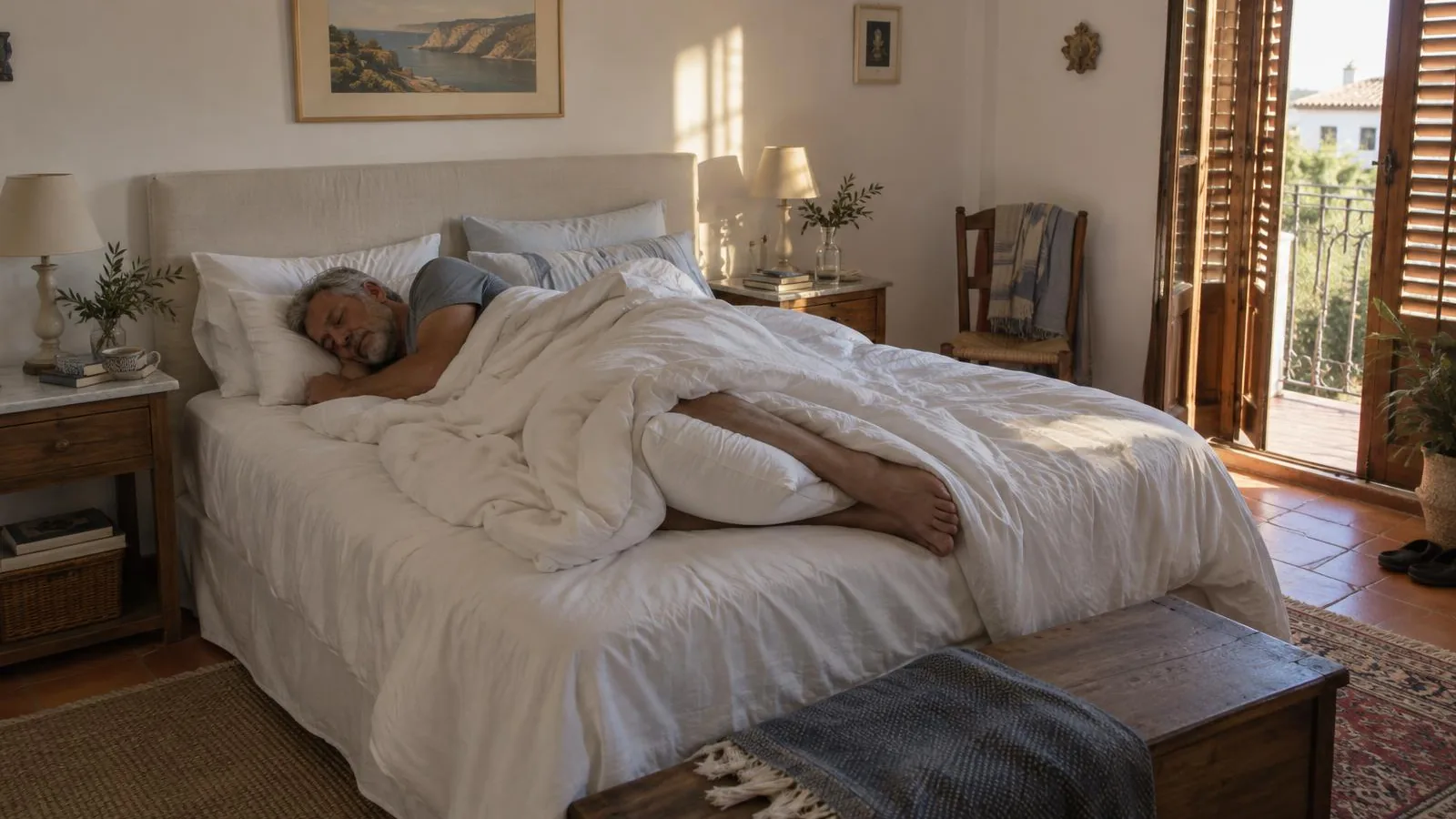
A pillow between the knees keeps the top leg level, which takes pressure off the gluteal tendon overnight.
Five everyday habits that keep trocanteritis grumbling
Gluteal tendons dislike being squeezed. Several perfectly normal habits do exactly that:
- Crossing your legs when you sit.
- Standing with your weight hanging on one hip.
- Sitting in low chairs, sofas or sunbeds with your knees above your hips.
- Stretching the outside of the hip hard (the classic “pull the knee across your body” stretch).
- Doubling your walking distance in a week because the weather is lovely.
Number four surprises people the most. That stretch feels like it should help, and for a minute it can. It also presses the tendon against the bone, which is the opposite of what an irritated tendon needs.
| What people often believe | What usually happens |
| “It’s bursitis, so I need an injection.” | The tendon is usually the main problem. An injection can calm pain for a while, but in the LEAP trial exercise did better over a year. |
| “I should stretch it out.” | Hard stretches across the hip compress the tendon and often make it worse. |
| “Rest until it stops hurting.” | Tendons lose strength with rest. They need gradual, well-chosen load. |
| “It’s arthritis, nothing to be done.” | Outer hip pain is often a tendon problem and responds well to treatment. |
What actually helps trocanteritis: the evidence in plain language
The best trial on this so far is the LEAP study (Mellor and colleagues, BMJ, 2018). Researchers in Brisbane and Melbourne split 204 people with gluteal tendinopathy into three groups: 14 physiotherapy sessions of education and exercise over eight weeks, one corticosteroid injection, or wait and see. At eight weeks the education and exercise group reported more overall improvement and less pain than both other groups. At one year the exercise group still reported better overall improvement than the injection group.
Injections are not useless. They gave quicker short-term relief than doing nothing, and for some people that window helps them start exercising. They just do not fix the tendon’s capacity on their own, which is why pain often returns once the effect fades.
What about shockwave therapy for the hip?
Shockwave therapy (ondas de choque) comes up a lot, often from neighbours who swear by it. The research is more mixed than the enthusiasm. The UK’s National Institute for Health and Care Excellence (NICE) reviewed shockwave for stubborn trochanteric pain and concluded the evidence on how well it works is limited, so it should be used with special arrangements for consent and audit. On whether it hurts: it is usually uncomfortable during the session and the intensity is adjusted to you. In the study NICE reviewed, 2 of 78 patients had increased pain lasting more than a day. If you are considering it, treat it as an add-on to an exercise programme, not a replacement.
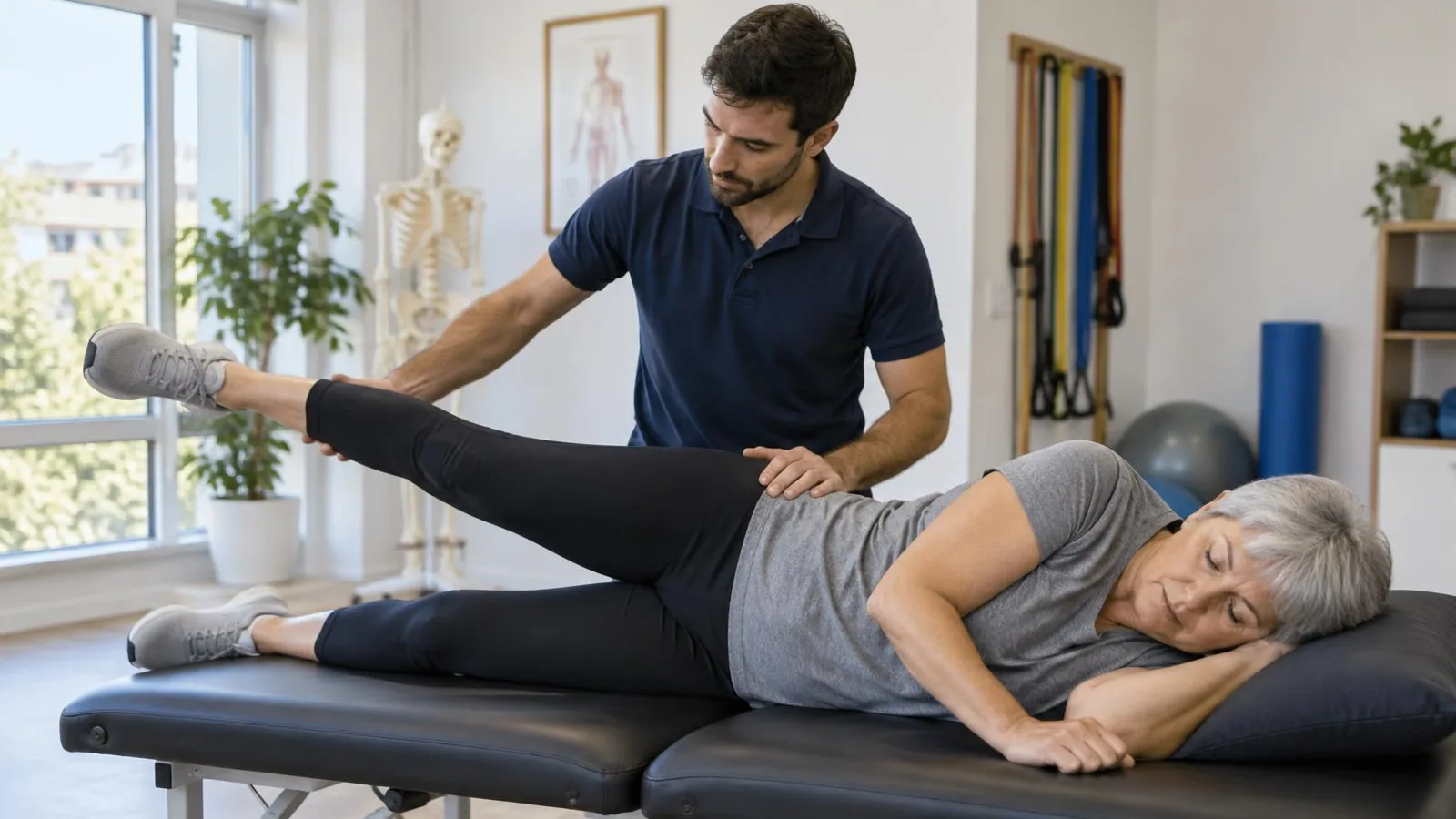
Strength testing in side-lying shows how well the gluteal tendons cope with load, which guides the exercise plan.
How NordicFysio assesses and treats outer hip pain
NordicFysio is an English and Swedish-speaking physiotherapy team with clinics in Punta Prima (Orihuela Costa), Ciudad Quesada (Rojales) and Aguas Nuevas (Torrevieja), focused on pain and mobility for people over 50. You do not need a GP referral to book.
A first hip assessment with us usually covers:
- A conversation about when it started, what changed in your routine and what you have already tried.
- Movement and strength tests, including the single-leg stand and resisted tests in side-lying.
- A check of your lower back and hip joint, so we do not treat the wrong thing.
- Where useful, diagnostic ultrasound in clinic to look at the gluteal tendons and bursa directly.
Treatment is built around a progressive exercise programme, because that is what the evidence supports. Depending on what we find, we may add advanced manual physiotherapy, the POLD method or SCENAR neuromodulation to settle pain while the tendon gets stronger, plus practical changes to sleep, sitting and walking. Many patients continue in our senior gym rehabilitation programme once the pain has calmed down. If you cannot drive while your hip is bad, we also offer home physiotherapy across the area.
An honest limit: physiotherapy will not make a 65-year-old tendon behave like a 25-year-old one, and if your hip joint itself is badly worn, we will tell you plainly and help you get the right medical opinion.
Three starter exercises for outer hip pain
These are gentle starting points used in many tendon programmes. Use this rule: mild discomfort up to 3 out of 10 is fine, as long as it settles by the next morning. If pain goes higher or lingers, stop and get assessed.
- Standing wall push. Stand side-on to a wall with the sore hip away from it. Lift the knee nearest the wall to hip height and press the side of that knee gently into the wall, keeping your pelvis level. Hold 30 to 45 seconds, rest, repeat 4 to 5 times.
- Glute bridge. Lie on your back, knees bent, feet hip-width apart. Squeeze your buttocks and lift your hips until your body is in a line from shoulders to knees. Lower slowly. 2 to 3 sets of 10.
- Sit to stand from a raised chair. Use a chair with a cushion so your hips stay above your knees. Stand up without using your hands, then sit down slowly. 2 to 3 sets of 8 to 10.
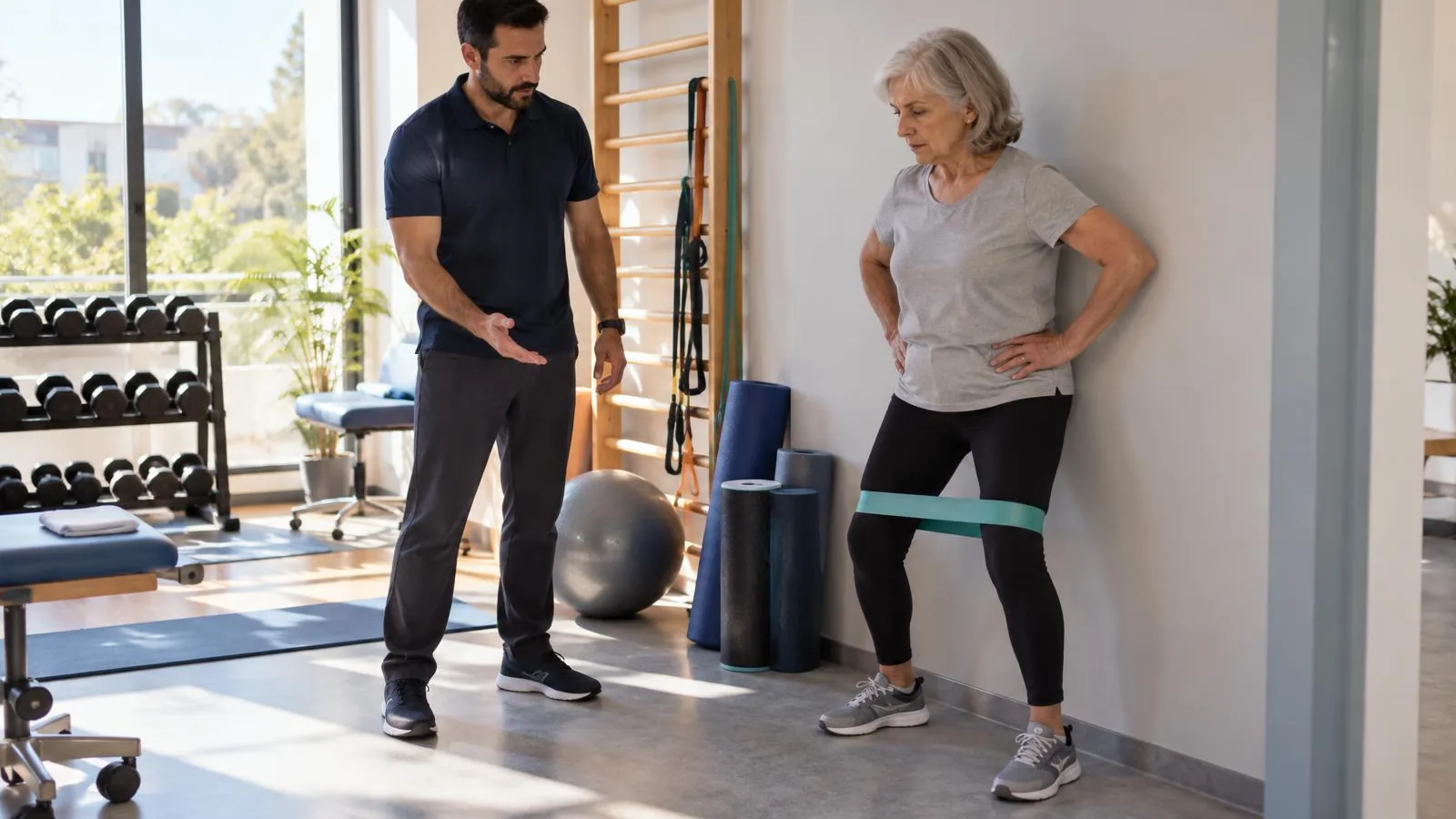
As pain settles, exercises progress from holds to bands and weights, which is how tendons rebuild their capacity.
Back to Ingrid. With a pillow between her knees, a raised cushion on the sofa, a shorter walk on flat ground for three weeks and these exercises, most of her night pain would likely settle well before her pádel partners noticed she had been away. Her full return to hills and sand would come later, built up step by step.

Pádel is great for the heart and the social life. Quick sideways lunges load the outer hip tendons hard, so build up gradually.
When outer hip pain needs a doctor quickly
Most outer hip pain is not dangerous. See a doctor promptly, or call 112 in an emergency, if you have any of these:
- A fall followed by being unable to put weight on the leg.
- A hot, red, swollen hip, or fever with hip pain.
- Unexplained weight loss, or a history of cancer, with new hip or back pain.
- Severe pain that does not ease with any position, day or night.
- Numbness around the groin or buttocks, or new problems with bladder or bowel control.
For the back-related warning signs in more detail, read when back pain is serious.
Where to get help for hip pain near you
We see hip pain patients from across the south of the Costa Blanca at three clinics:
- NordicFysio Punta Prima, convenient for Orihuela Costa: La Zenia, Playa Flamenca, Cabo Roig, Villamartín, Los Dolses and Lomas de Cabo Roig.
- NordicFysio Ciudad Quesada, for Rojales, Benijófar, Formentera del Segura, Algorfa and the wider Vega Baja.
- NordicFysio Aguas Nuevas, for Torrevieja town, La Mata, Los Balcones and Torreta.
Frequently asked questions about outer hip pain
Is walking good for trocanteritis?
Walking is usually fine at a distance your hip tolerates, on flat ground. Cut back on hills, sand and long walks for a few weeks, then build up again gradually. Stopping completely tends to weaken the tendon further.
How long does trocanteritis take to get better?
Night pain often eases within a couple of weeks of changing sleep position and daily habits. Tendon strength takes longer: the LEAP programme ran for eight weeks, and a full return to hills, sport and long walks commonly takes a few months.
Should I get a cortisone injection for hip bursitis?
An injection can reduce pain in the short term. In the LEAP trial, education and exercise gave better results over a year, so if you have an injection, use the calmer weeks to start a proper exercise programme.
Can I keep playing pádel or golf with outer hip pain?
Often yes, at a reduced level. Shorter matches, fewer sideways lunges, and nine holes instead of eighteen keep you active while the tendon recovers. A physiotherapist can set clear limits for your case.
Do I need a scan for hip pain?
Most people do not need an MRI to start treatment. A clinical assessment usually identifies the pattern, and ultrasound in clinic can show the tendons and bursa when there is doubt.
Do I need a doctor’s referral to see a physiotherapist in Spain?
Not at a private clinic. You can book NordicFysio directly, without a GP referral, in English, Swedish or Spanish.
Book a hip assessment in Orihuela Costa, Torrevieja or Ciudad Quesada
If the outside of your hip is spoiling your walks, your sleep or your pádel, a proper assessment can tell you which structure is the problem and what to do about it. Book a free consultation at the clinic nearest you, or call +34 670 592 434.
This article is general information and does not replace an individual assessment. If you are unsure about your symptoms, speak to a physiotherapist or doctor.
Sources
- Mellor R, et al. Education plus exercise versus corticosteroid injection use versus a wait and see approach on global outcome and pain from gluteal tendinopathy: prospective, single blinded, randomised clinical trial. BMJ 2018;361:k1662. org/10.1136/bmj.k1662
- Segal NA, et al. Greater trochanteric pain syndrome: epidemiology and associated factors. Arch Phys Med Rehabil 2007;88(8):988-992. PubMed 17678660
National Institute for Health and Care Excellence. Extracorporeal shockwave therapy for refractory greater trochanteric pain syndrome (IPG376). nice.org.uk/guidance/ipg376